
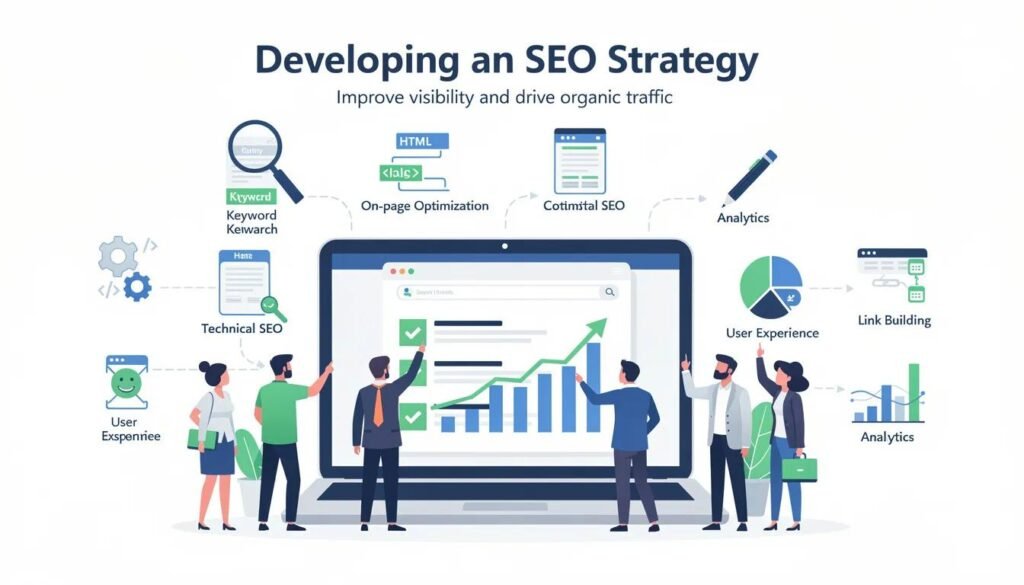
SEO is more than just ranking on Google. While getting your website to appear higher in search results is an important part of SEO, it is not the only measure of success. A website can rank well and still struggle to attract the right audience, provide a good user experience, generate leads, or convert visitors into customers.
A successful SEO strategy goes beyond rankings. It focuses on making your website more visible, useful, trustworthy, accessible, and valuable to both search engines and users. If you want sustainable organic growth, understanding why SEO is more than just ranking is essential.
Why SEO Is More Than Just Ranking
When people think about SEO, they often think about keywords, Google rankings, and the first page of search results.
But ranking is only the beginning.
Imagine your website ranks #1 for an important keyword but the page loads slowly, the content does not answer the user’s question, or there is no clear next step for the visitor.
You may have a great ranking, but you may not have a great SEO result.
This is why SEO is more than just ranking. The real objective is to attract the right visitors, give them a valuable experience, build trust, and encourage meaningful actions.
1. SEO Is About Visibility, Not Just Rankings
Ranking is one part of search visibility, but SEO should help your website become discoverable across different types of searches.
Your website may appear for:
- Informational searches
- Product-related searches
- Local searches
- Brand searches
- Long-tail keywords
- Question-based searches
A strong SEO strategy focuses on building overall search visibility instead of obsessing over one keyword position.
The goal is not simply to say, “We rank #1.”
The better question is:
“Are the right people discovering our website when they need what we offer?”
That is another reason SEO is more than just ranking.
2. SEO Is About Getting the Right Traffic
More traffic does not automatically mean better results.
Suppose a website receives 100,000 visitors every month, but most of those visitors are not interested in its products or services.
Another website may receive 10,000 visitors, but those visitors are highly relevant and more likely to become customers.
Which website is performing better?
This is why an effective SEO strategy focuses on qualified organic traffic rather than traffic numbers alone.
Keyword research should therefore consider:
- Search intent
- Audience needs
- Relevance
- Competition
- Business goals
The objective is to attract people who are actually looking for the information, products, or services your website provides.
3. SEO Is About Content Quality
SEO is more than just ranking because search visibility means little if the content does not provide value.
Users visit a website because they want an answer, solution, comparison, explanation, product, or service.
Your content should therefore:
- Answer the user’s question
- Be easy to understand
- Provide useful information
- Be accurate and relevant
- Demonstrate expertise
- Offer something genuinely valuable
Instead of creating content only because a keyword has search volume, create content because your audience needs it.
A strong SEO strategy connects keyword research with content that people actually want to read.
4. SEO Is About User Experience
Getting someone to your website is only one part of the journey.
What happens after they arrive also matters.
If your website is slow, difficult to navigate, confusing, or poorly designed, visitors may leave even if the page ranks well.
Your SEO strategy should therefore consider:
- Website speed
- Mobile experience
- Navigation
- Readability
- Page structure
- Accessibility
- Internal linking
- Clear calls to action
This demonstrates why SEO is more than just ranking. Search visibility brings people to your website, but the experience determines what happens next.
5. SEO Is About Building Trust
A website needs more than visibility to build a strong online presence.
People are more likely to trust websites that provide reliable information, demonstrate expertise, and clearly communicate who they are.
Trust can be strengthened through:
- Accurate and useful content
- Author expertise
- Original insights
- Transparent information
- Quality references
- Positive brand presence
- Consistent content
An effective SEO strategy should therefore help establish your website as a credible source within your industry.
6. SEO Is About Conversions, Not Just Clicks
One of the biggest reasons SEO is more than just ranking is that rankings and traffic are not the final business objective.
A visitor may:
- Purchase a product
- Submit a form
- Request a demo
- Subscribe to a newsletter
- Contact your business
- Download a resource
- Read multiple pages
- Return to your website later
These actions can be more valuable than simply increasing your ranking position.
For this reason, businesses should connect their SEO strategy with broader marketing and business objectives.
7. SEO Is About Long-Term Growth
SEO is not a one-time task.
Search trends change. Competitors publish new content. Websites change. User expectations evolve. Search engines also continue to improve how they understand and evaluate content.
That means an effective SEO strategy requires continuous:
- Content updates
- Technical improvements
- Keyword research
- Performance analysis
- Competitor research
- User experience improvements
Instead of asking only, “What position does my page have today?” businesses should also ask, “Is my website becoming more useful, visible, and valuable over time?”
That is what sustainable SEO looks like.
SEO Is More Than Just Ranking: What Should You Measure?
If SEO is more than just ranking, your measurement strategy should also go beyond keyword positions.
Depending on your business goals, you can monitor:
| SEO Metric | What It Can Tell You |
|---|---|
| Organic traffic | How many visitors come through search |
| Search visibility | How visible your website is across relevant searches |
| Click-through rate | How often people choose your result |
| Engagement | How visitors interact with your content |
| Conversions | Whether organic visitors take valuable actions |
| Leads | Whether SEO contributes to potential customers |
| Revenue | Whether organic search contributes to business growth |
| Returning visitors | Whether your content creates lasting value |
Rankings are still useful. They simply should not be the only thing you measure.
How to Build an SEO Strategy Beyond Rankings
If you want your SEO strategy to deliver more than rankings, focus on the complete user journey.
Step 1: Understand Your Audience
Find out what your audience searches for, what problems they have, and what information they need.
Step 2: Understand Search Intent
Do not target keywords simply because they have high search volume. Understand why someone is searching for them.
Step 3: Create Valuable Content
Build content that answers real questions and provides useful information instead of writing only for search engines.
Step 4: Improve Your Website
Make your website fast, mobile-friendly, easy to navigate, and technically accessible.
Step 5: Build Authority
Create trustworthy content and develop a strong presence within your industry.
Step 6: Optimize for Action
Make it easy for visitors to contact you, purchase, subscribe, enquire, or take whatever action matters to your business.
Step 7: Track and Improve
Analyze your SEO performance regularly and improve your strategy based on actual data.
The Bottom Line: SEO Is More Than Just Ranking
SEO is more than just ranking.
A high position on Google can bring visibility, but visibility alone does not guarantee success. The real value of SEO comes from attracting the right audience, providing valuable content, creating a positive website experience, building trust, and turning organic traffic into meaningful results.
So, instead of asking only:
“How can I rank #1?”
Start asking:
“How can I make my website the best result for the person searching?”
That mindset creates a much stronger SEO strategy — one focused not only on rankings, but also on visibility, relevance, experience, trust, conversions, and long-term growth.
Pingback: How to Rank on Google and AI Search: A Complete SEO Guide